[ Home ] [ Up ] [ Seedlist A-AK ] [ Seedlist AL-AN ] [ Seedlist AP-AZ ] [ Seedlist B ] [ Seedlist CA ] [ Seedlist CE-CL ] [ Seedlist CN-CZ ] [ Seedlist DA-DE ] [ Seedlist DI-DZ ] [ Seedlist EA - ER ] [ Seedlist ES - EZ ] [ Seedlist F-G ] [ Seedlist H ] [ Seedlist I-K ] [ Seedlist LA-LE ] [ Seedlist LI ] [ Seedlist LO-LZ ] [ Seedlist M ] [ Seedlist N ] [ Seedlist O-PA ] [ Seedlist PE-PH ] [ Seedlist PI-PZ ] [ Seedlist Q-R ] [ Seedlist SA-SH ] [ Seedlist SI-SZ ] [ Seedlist TA-TO ] [ Seedlist TR-TZ ] [ Seedlist U-V ] [ Seedlist W-Z ] [ Vegetable Seed A - D ] [ Vegetable Seed E - R ] [ Vegetable Seed S - Z ] [ Organic Seeds ] [ Books ] [ Bulk Seed List ] [ Reserved Access ]
J.
L. HUDSON, SEEDSMAN,
BOX 337, LA
HONDA, CALIFORNIA
94020-0337 USA
2024 SEEDLIST - Pi - Pz
How to Request Seeds
Request Form for requests sent by
the postal service.
Online Requests for e-mail
requests with PayPal payment only.
Don't forget postage and
packing!
Bulk Seed
PICEA (PEE-say-a)
PINACEAE. Attractive N. Hemisphere, conifers with pendulous cones. Grown for
ornament or timber. Most soils and zones, and easy from seed.
—Picea likiangensis. (100) PICA-26. Packet: $2.50
1/4 Ounce: $12.00
'LIJIANG SPRUCE'. Tree to 100 feet, with green to blue-green 1/2"
needles. Grey scaly bark and 3" cones that may be reddish or purple when
young. SW China and Tibet. Zone 7. "In April and May when loaded with
its male flowers and brilliant red young cones it is spectacularly
beautiful."—Hilliers. Germinates in 2 - 4 weeks warm.
—Picea mongolica. (50) PICA-32. Packet: $2.50
5 grams: $12.50
'MONGOLIAN SPRUCE'. Rare tree to 90 feet, with inch-long needles, grey-brown bark, and 3" cones. Mongolia. Zone 2. Good in harsh deserts. Considered 'near threatened'. Prechill 3 weeks.
PIMPINELLA (pim-pi-NEL-a)
UMBELLIFERAE. Herbs with white or yellow flowers in umbels, and feathery
leaves. Best sown directly to not-too-rich soil. Germinates in 1 - 6 weeks.
—Pimpinella Anisum. (1000) PIM-1. Packet: $2.00
Ounce: $6.00, 1/4 Pound: $15.00
'ANISE'. White flowers. A dainty annual to 1 1/2 - 2 feet, with feathery
bright green leaves. Greece to Egypt. Grown for the popular seeds used as a
condiment for bread, pastries and cheese, to flavor liqueurs, and medicinally.
Known to the ancient Greeks, it is mentioned by Dioscorides, Theophrastus, and
Pliny. The leaves may be used in salads. Medicinally the seeds and oil are used
as estrogenic agents to promote milk secretion, regulate and promote
menstruation, ease birth, and allay symptoms of menopause. A number of synthetic
estrogens were originally modeled after the estrogenic compounds found in the
oil. Anise still has merit in that it is non-carcinogenic, has low toxicity, and
is gentle in action. Not to mention you don't need a prescription, and it is low
cost. See: 'Fennel and Anise as Estrogenic Agents'. Journal of Ethnopharmacology
(1980) Vol. 2, pages 337 - 344.
PINELLIA (pi-NELL-ee-a)
ARACEAE. Ornamental E. Asian summer-growing arums. Best in moist part shade.
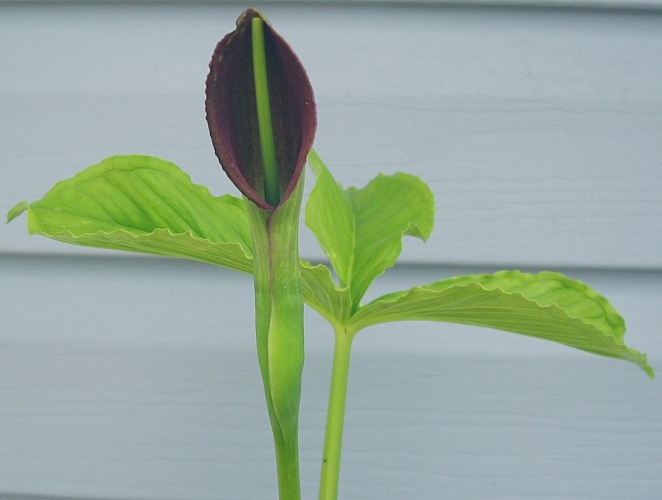
—Pinellia tripartia 'Atropurpurea'. (20) PINE-24A. Packet: $2.50
Click for photo » 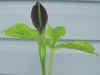
'PURPLE DRAGON'. Purple 4" spathes in spring and summer, with long
green tails. Bulb to 18", with shiny three-parted leaves. Japan. Zone 5.
Stands shade.
PINUS (PEE-nus or PYE-nus)
PINACEAE. North Hemisphere evergreen conifers. The pines are popular and
widely adapted. Valuable for timber, ornament, fuelwood, rosin, turpentine, and
edible seeds. Best in well-drained soil.
—Pinus attenuata. (25) PINU-6. Packet: $2.50
1/4 Ounce: $15.00
Info: http://www.conifers.org/pi/Pinus_attenuata.php
Tree: http://calphotos.berkeley.edu/cgi/img_query?enlarge=7335+3182+4411+0061
Branch with cones: http://calphotos.berkeley.edu/cgi/img_query?enlarge=0000+0000+0602+0342
'KNOB-CONE PINE'. Small tree to 6 - 40, even 80 feet, with slender light
green 3 - 7" needles and 6" cones. Oregon and California. Zone 6.
Germinates in 2 - 8 weeks with no prechill.
—Pinus durangensis. (10) PINU-16. Packet: $2.50
Info and photos: http://www.conifers.org/pi/Pinus_durangensis.php
'DURANGO PINE'. Dark green 6 - 10" needles and 3" cones. Tree to 130
feet, with grey-brown bark. Mts. of W. México. Zone 8. The only pine with
needles in sixes. Germinates in 2 - 3 weeks.
—Pinus Lambertiana. (15) PINU-32. Packet: $2.50
Photo: http://calphotos.berkeley.edu/cgi/img_query?enlarge=0000+0000+1202+0928
Cones: http://www.esacademic.com/pictures/eswiki/83/Sugarpine.jpg
'SUGAR PINE'. The tallest pine, to 220 feet, with 2 - 4" needles and 8
- 24" long cones, the largest in the genus. Oregon to Baja. Zone 7. The
large seeds are eaten, and it exudes a sweet sap. Give 2 - 3 month prechill 10
germinate in a month.
—Pinus Massoniana. (50) PINU-37. Packet:
$2.50
'CHINESE RED PINE'. To 80 feet, with thin, light green 8" needles and
3" cones. China. Zone 7. Germinates in 2 - 4 weeks warm.
—Pinus Mugo Mughus. (25) PINU-44. Packet: $3.00
5 grams: $10.00
'DWARF SWISS MOUNTAIN PINE'. Low shrub to 4 feet, with crowded 2"
needles and 2" cones. Alps. Zone 3. Very ornamental. Produces Hungarian
terebinth. Germinates in 2 - 24 weeks warm.
—Pinus Pinea. (10) PINU-62. Packet: $2.50
1/4 Pound: $20.00 BULK OUT OF STOCK -
packets are still available
'ITALIAN STONE PINE', 'UMBRELLA PINE'. Round-topped tree to 40 - 80 feet,
with stiff, bright to grey green 8" needles, and 4" cones.
Mediterranean. Cultivated for the large, sweet, edible nuts. Considered sacred
to Poseidon by the ancient Greeks. Zone 8. Germinates in 1 - 4 weeks warm. Some
lots are sensitive to warm temperatures and need cool temperatures to germinate.
—Pinus Roxburghii. (=longifolia) (25) PINU-72. Packet: $2.50
Ounce: $7.50, 1/4 Pound: $20.00
'CHIR' or 'EMODI PINE'. Beautiful Himalayan pine to 80 feet, with long,
drooping, light green 12" needles and 7" cones. Zone 6. The seeds are
eaten in India. Germinates in 2 - 4 weeks with no prechill needed.
—Pinus tabulaeformis. (50) PINU-77. Packet: $2.50
Info: http://www.conifers.org/pi/Pinus_tabuliformis.php
Photo: http://www.plantphoto.cn/tu.aspx?id=87950
Photo of needles and cones: http://www.plantphoto.cn/tu.aspx?id=28060
'CHINESE RED PINE'. To 80 feet, with 4-6" needles and 3" cones.
Northern China. Zone 4 or 5. Germinates in 2 - 4 weeks warm.
—Pinus taiwanensis. (50) PINU-79. Packet: $2.50 OUT
OF STOCK
1/4 Ounce: $14.00 OUT
OF STOCK
Info: http://www.conifers.org/pi/Pinus_taiwanensis.php
'TAIWAN PINE'. To 100 feet or more, with 4 1/2" needles and 2"
cones. Endemic to the mountains of Taiwan. Zone 8. Germinates in 1 - 4 weeks.
—Pinus Torreyana. (10) PINU-97. Packet: $4.00
'TORREY PINE'. Small round-headed tree to 60 feet, often gnarled in the
wild. Stiff dark green 8 - 12" needles and round 6" cones. Rare
endemic, only a few thousand trees occur in a small spot on the San Diego coast
and on Santa Rosa Island. Large edible seeds. Zone 7. Germinates in 4 - 6 weeks
and a 4 week prechill often helps.
PLATYCODON (pla-te-KO-don)
CAMPANULACEAE. 'BALLOON FLOWER'. A single species. A showy hardy perennial
thriving in well drained sandy loam. Easy from seed; blooms the second year. The
flower buds are inflated and balloon-like before they open. Allow stems to die
back in fall. Germinates in 1 - 3 weeks at warm temperatures. Do not cover seed.
The young leaves are used in salads in Japan. Native to eastern Asia.
—Platycodon grandiflorus 'Florist Blue'. (100) PLTY-1B. Packet: $2.50
Gram: $7.50, 5 grams: $15.00
'BLUE BALLOON FLOWER' Large blue 3" flowers. Showy perennial to 2 feet.
Zone 4. Germinates in 1 - 3 weeks.
—Platycodon grandiflorus 'Fuji Pink'. (100) PLTY-1FP. Packet: $2.50
'FLORIST PINK'. Large pink 3" flowers. Showy perennial to 20".
Zone 3. Germinates in 1 - 2 weeks.
POGOSTEMON (po-go-STEM-on)
LABIATAE. Tropical Asian herbs for fragrance.
—Pogostemon cablin. (300) POGO-6. Packet: $3.00
1/4 Gram: $18.00, Gram: $50.00
'TRUE PATCHOULI'. Tropical shrublet to 2 - 3 feet with very fragrant mauve
flowers in 1 - 3" spikes, and 2 - 4" leaves. East Indies. Zone 9b or
10. The main source of patchouli oil. Used for fragrance, medicinally, and
seasoning. Smells like a VW bus full of hippies. Best in warm places with part
shade. Germinates in 1 - 6 weeks. Aged seed best, and light and GA-3 helps.
Info and photos link: http://davesgarden.com/guides/pf/go/53931/
—Pogostemon heyneanus. (200) POGO-11. Packet: $3.00
1/4 Gram: $12.00, Gram: $35.00
'INDIAN PATCHOULI'. Small purple flowers in spikes on a shrubby tropical
perennial to 5 - 6 feet, with highly fragrant leaves. Tropical Asia. Zone 10.
Prefers full to part shade, good houseplant. One of the sources of patchouli
oil. Germinates in 1 - 6 weeks.
POINCIANA (poin-see-A-na)
LEGUMINOSAE. Showy warm-region small broad-crowned trees and shrubs with
feathery pinnate foliage and spectacular flowers. Fast growing heat lovers, best
in well-drained soil. Drought-resistant thriving in hot sun and warm regions,
north to Oregon. Easy in pots in the greenhouse. Easy from seed, grow like Caesalpinia,
which see.
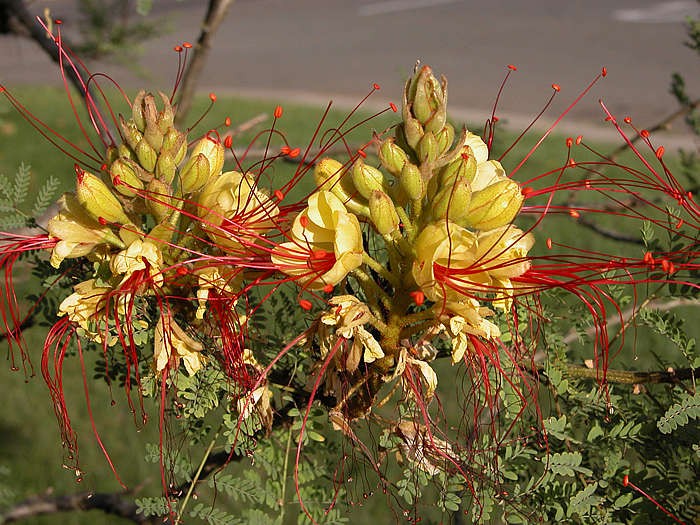
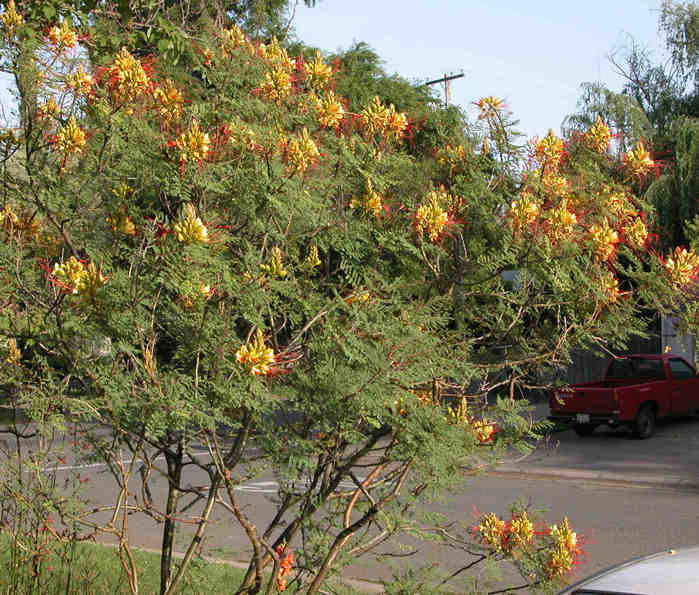
—Poinciana Gilliesii. (=Caesalpinia Gilliesii) (10) POIN-2. Packet: $2.50
Ounce: $12.00, 1/4 Pound: $40.00
Click for photos » 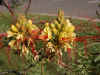
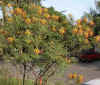
'BIRD of PARADISE BUSH'. Striking flowers with 3 - 5" long bright red
stamens from 5-petaled yellow flowers in dense clusters. Blooms all summer.
Shrub or small tree with feathery foliage. South America. Fast growing to 10 to
20 feet or so. An excellent ornamental, good in desert areas and the South, but
grown as far north as Oregon. Zone 8. Easy in pots in the greenhouse in the
North, and said to be possible as an annual if started early. The stamens have
been used as a saffron substitute. "A very showy and worthy plant."—L.
H. Bailey. Nick seed, germinates in 1 - 3 weeks.
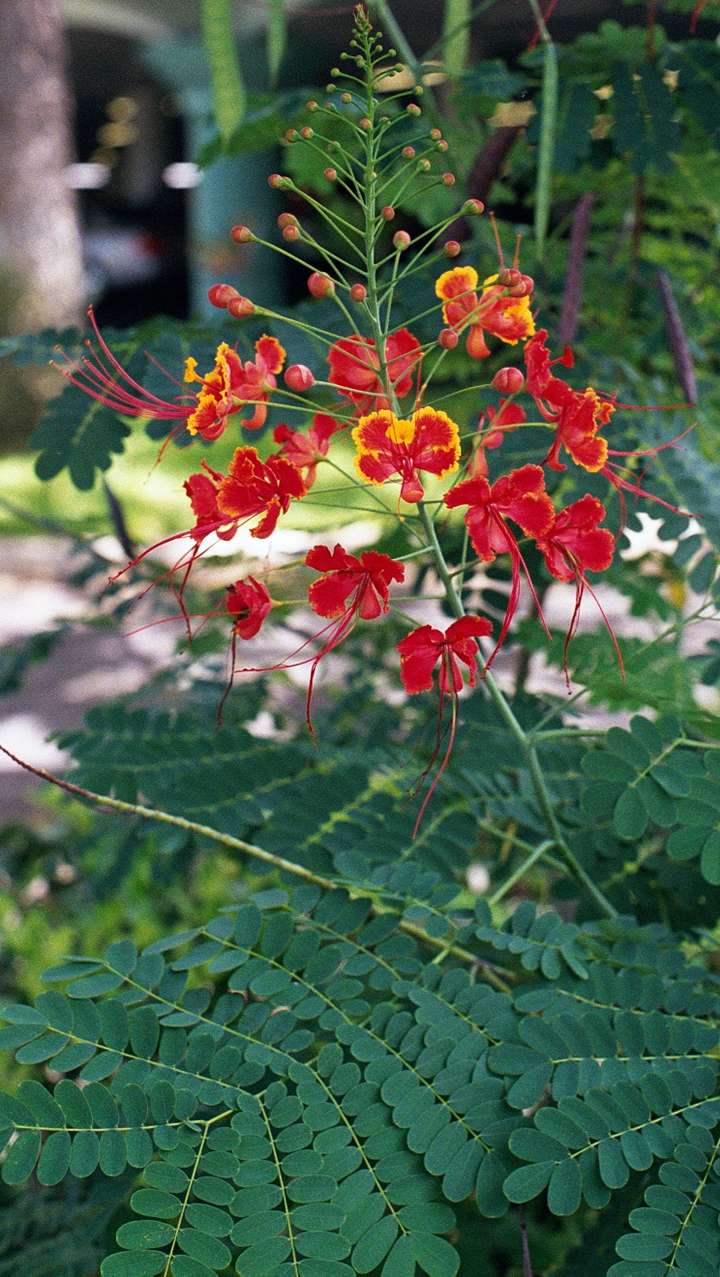
—Poinciana pulcherrima. (=Caesalpinia pulcherrima) (10) POIN-4. Packet:
$2.50
Ounce: $9.00, 1/4 Pound: $30.00 NEW PRICE
Click for photo » 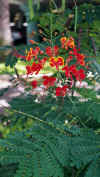
'PRIDE OF BARBADOS', 'DWARF POINCIANA', 'FLOWER FENCE'. Striking flowers
with red crinkled petals edged yellow, and bright 2 1/2" red stamens. Dense
shrub to 10 feet with delicate dark green feathery foliage. West Indies. Zone 9.
Fast growing, good hedge or screen in warm regions, blooming throughout warm
weather. Stands some frost. Sacred in India. The seed and pods yield tannin and
dye, and the orange colored wood is carbonized for ink in India. Leaves used as
a fish poison in Guatemala. All parts have medicinal uses, and extracts have
shown antiviral effects. Nick seed to germinate in 2 - 3 weeks.
—Poinciana regia: See Delonix regia.
POLEMONIUM (po-le-MO-nee-um)
POLEMONIACEAE. Mostly easily grown perennials for the border. Blue, yellow
or purplish flowers. Best from fall-sown seed in rich loam. Common kinds
germinate in 1 - 4 weeks at warm.
—Polemonium caeruleum Blue Pearl. (100) POLE-4. Packet: $2.50
Gram: $7.50
'JACOB'S LADDER', 'CHARITY', 'GREEK VALERIAN'. Gorgeous sky blue 1"
drooping flowers with yellow stamens. Hardy perennial to 3 feet, with fern-like
foliage. Europe. Likes moist wet ground. Cats are fond of the scent and will
roll in the plants. Was used medicinally as an alexipharmic, etc.
—Polemonium yezoense 'Purple Rain Strain'. (50) POLE-28P. Packet: $2.50
Gram: $9.50
Large violet inch-wide flowers in June and July. Hardy perennial to
20", with pinnate leaves. Japan. Zone 4. Until early summer the whole plant
is reddish-purple, making a nice display. Germinates in 1 - 6 weeks or so.
POLYGONATUM
LILIACEAE. Robust hardy woodland perennials grown for their handsome foliage
and graceful arching branches. Best in shady places, but they do well in the
border. Ideal for woodland and under trees, where they form nice colonies. Sow
in fall or give warm then cold treatment.
—Polygonatum biflorum. (50) POLO-2. Packet: $2.50
5 grams: $7.50
'SMALL SOLOMON'S SEAL'. Bell-shaped greenish 1/2" flowers in small clusters
in April to July. Hardy perennial to 1 - 3 feet, with graceful arching branches
and attractive foliage. E. N. America. "Wonderful in shade
gardens."—Guttendorf. Best sown in fall, or prechill 4 months to
germinate in 1 - 2 months.
POLYMNIA (po-LEEM-nee-a)
COMPOSITAE. From the warm Americas.
NEW—Polymnia uvedalia. (20) POLM-44. Packet: $2.50
Medicinal info: http://doctorschar.com/archives/bearsfoot-polymnia-uvedalia/
'BEAR'S FOOT'. Bright yellow daisies on a hardy perennial to 6 - 10 feet,
with large lobed leaves. SE U.S. Zone 5 (maybe). Good in wet places. The root is
used in medicine. Irregular germination, give a prechill, and Richo Cech reports
fire works well.
POLYSTICHUM (po-LIS-ti-kum)
POLYPODIACEAE. Mostly temperate zone woodland ferns grown for ornament.
Easily grown. Prefers limestone and leafmold. See Fern Spores for germination.
—Polystichum munitum. (10,000) POLYS-12. Packet: $2.50
Gram: $7.50
'GIANT HOLLY FERN', 'WESTERN SWORD FERN'. Large, deep green, pinnate,
leathery evergreen fronds to 10" wide, in large clumps to 3 to 5 feet tall.
Striking and hardy, living to great age. Alaska to California. The thick roots
were peeled and roasted in embers or cooked like potatoes with salmon eggs by
Northwest Indians. Said to have a banana-like flavor. I've got to try it
someday! Spores germinate in 2 weeks, prothallia form in the next few weeks or
so.
POROPHYLLUM (por-o-FEE-lum)
COMPOSITAE. From the warm Americas.
—Porophyllum ruderale. (100) PORO-21. Packet: $2.50
Gram: $7.50
Photos and info: http://www.fireflyforest.com/flowers/3167/porophyllum-ruderale-yerba-porosa/
http://davesgarden.com/guides/pf/go/99940/
'PAPALO QUELITE', 'SUMMER CILANTRO'. Annual to 4 feet, with oval roundish
leaves and small flowers. México to S. America. Zone 9 or 10. Distinctive
cilantro-like flavor, but more citrusy. Added to salads, tacos, guacamole, and
salsas. Does well when too hot for cilantro. Full or part sun. Year old seed
germinates in 1 - 2 weeks, fresh seed needs GA-3.
PORTULACA (por-tu-LA-ka)
PORTULACEAE. 'MOSS ROSE'. Somewhat succulent low-growing herbs grown for
their brilliant flowers or as potherbs. Sun lovers, preferring poor, dry, light
soils and only a little water, providing a showy, dense carpet of color in hot
areas where other flowers would soon perish. Try several to a 6" pot. Sow
in March at 65 - 75°F, or outdoors in April. Germinates in 1 - 3 weeks. Seed
viable 3 - 10 years, and some up to 45 years.
—Portulaca grandiflora 'Single Mix'. (1000) PORT-1S. Packet: $2.50
5 grams: $6.00, 25 grams: $16.00
Large single flowers in a range of colors. This is the old-fashioned type
not often seen nowadays.
POTENTILLA (po-ten-TIL-a)
ROSACEAE. A very large genus of mostly hardy perennials. Yellow, red, or
white flowers, and divided leaves. Good in the border or wild garden. Sow in
fall or early spring. February in a cold frame. Most germinate in 1 - 4 weeks,
some up to 8 weeks. Most kinds bloom the second year. Name means 'powerful',
referring to the medicinal properties. Need little care.
—Potentilla atrosanguinea Red. (100) POTL-9. Packet: $2.50
Red inch-wide flowers in much-branched clusters in summer. Hardy perennial
forming a mound to 18" tall. Himalayas. Germinates in 2 - 6 weeks.
—Potentilla nepalensis 'Helen Jane'. (250) POTL-88H. Packet: $2.50
Abundant brilliant pink inch-wide flowers with red eyes, in summer. Compact
hardy perennial to 1 foot, with palmate leaves. Himalayas. Zone 5. Germinates in
1 - 2 weeks.
—Potentilla Thurberi 'Monarch's Velvet'. (100) POTL-120M. Packet: $2.50
Deep velvety red 1/2 - 3/4" flowers with dark centers, in June to
August. Hardy perennial to 2 1/2 feet, with divided leaves. New Mexico to
California. Germinates in 1 - 2 weeks.
PRIMULA (PRIM-you-la)
PRIMULACEAE. 'PRIMROSE'. A large genus of mostly cool-region hardy and half
hardy perennials grown for their beautiful, showy winter and spring bloom.
Popular for pot plants, bedding, in the rock garden, greenhouse and border. Most
like deep, moist, well-drained soil and part shade. Mulch to keep soil cool. Sow
seed in late fall or early spring; several weeks to months cold is beneficial to
most hardy kinds. Most need light, sow on the surface and keep cool, best under
65°F. They may be irregular in germinating, taking from 2 - 10 weeks or more;
usually 20 - 40 days. Seed viable 1 - 5 years.
—Primula alpicola. (75) PRIM-8. Packet: $3.50
Clusters of 3,4" wide flowers ranging from light yellow to white and violet. Hardy perennial to 20". Tibet. Zone 5. Prefers wet soil.
—Primula Beesiana. (200) PRIM-14. Packet: $3.50
Purple-red 3/4" flowers with yellow eye, in candelabra clusters. Hardy perennial to 16", blooming in June and July. W. China. Zone 5.
—Primula chungensis. (200) PRIM-26. Packet: $3.00
Fragrant pale orange 3/4" flowers in clusters in summer. Hardy perennial to 2 feet or so, with a rosette of foot-long leaves. China, Himalayas. Zone 6.
—Primula japonica 'Miller's Crimson'. (100) PRIM-85M. Packet: $2.50
Deep intense red 1 - 1 1/2" flowers in tiered clusters to 1 1/2 - 2 feet,
May to July. Hardy perennial with grey-green rosettes of 8 - 12" leaves.
Japan. Zone 5. Give seed 250ppm GA-3 or prechill 8 weeks.
—Primula macrocalyx. (100) PRIM-100. Packet: $2.50
Large yellow to orange 1 1/4" fragrant flowers in clusters to 15"
tall. Hardy perennial. Central Asia. Zone 4. "Like P. veris on steroids.
More robust in all its parts."—Bertrand. Give seed GA-3 to germinate
in 4 - 6 weeks.
—Primula veris. (=officinalis) (100) PRIM-165. Packet: $2.50
'COWSLIP', 'MAYFLOWER', 'KEY OF HEAVEN'. Bright yellow fragrant nodding
inch-wide flowers clustered on 8 - 12" stems in spring. The petals each
have a red spot. Attractive rosettes of crinkled leaves. Europe. Zone 4. A
legendary plant of the herbalists, with a long history of use. Norse mythology
dedicated it to the goddess Freya, and it was held to be the entrance to her
treasure palace. The sedative flowers are made into cowslip wine, an old folk
remedy for insomnia, giddiness, and nervous troubles. The fresh blossoms are
added to salads or are made into conserves. They were once held in high esteem
as a cosmetic, believed to remove spots and wrinkles. Seed viable 2 - 5 years.
Give seed 2 weeks warm, then 8 weeks cold, to sprout in 1 - 8 weeks.
—Primula veris 'Sunset Shades'. (50) PRIM-165S. Packet: $3.00
Flowers in shades of red, orange, ochre, and yellow, from March to May.
Hardy perennial to 10". Zone 4.
PRUNELLA (proo-NELL-a)
LABIATAE. Showy-flowered low growing perennials from north temperate
regions. Easily grown long blooming, attracts pollinators and good groundcover.
—Prunella vulgaris. (100) PRUL-25. Packet: $2.50
5 grams: $7.50 BULK OUT OF STOCK -
packets are still available
'SELF-HEAL', 'HEAL-ALL'. Violet-blue 1/2" flowers in short, dense
spikes, in May to October. Hardy perennial to 4 - 20", with 4" leaves.
Eurasia. Zone 3. Highly regarded medicinal herb. Sow on the surface. Germinates
in 2 - 8 weeks warm.
NEW—Prunella vulgaris var. lanceolata. (500) PRUL-25L. Packet: $2.50
5 grams:
$7.50
'LANCE-LEAF HEAL-ALL'. Abundant violet flowers in larger heads than the
European form. Hardy perennial to 2 feet, blooming May to August. The native
North American form, an important plant for pollinators, and medicinal.
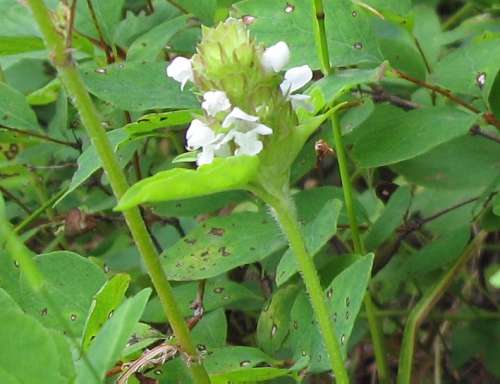
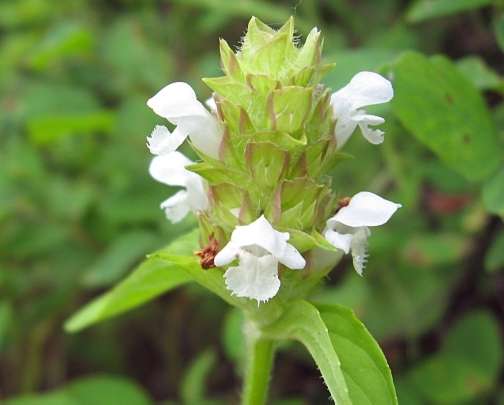
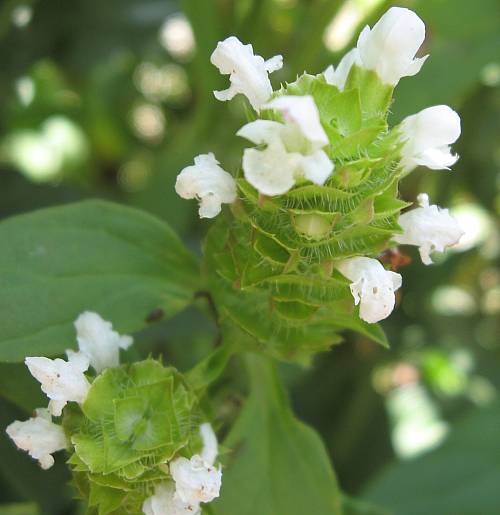
—Prunella vulgaris White. (400) PRUL-25W. Packet: $2.50
Click for photo » 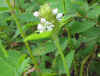
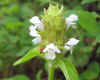
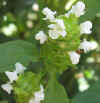
'WHITE SELF-HEAL'. White 1/2" flowers in dense spikes in summer. Hardy
perennial with 4" leaves. Eurasia. Zone 3. Germinates in 2 - 3 weeks.
PRUNUS (PROO-nus)
ROSACEAE. Ornamental flowering trees and shrubs. Many produce edible fruits or
nuts. Easily grown, and making a great display of bloom in spring.
—Prunus Lyonii. (5) PRUN-76. Packet: $2.50
1/4 Pound: $15.00 (about 14 seeds per ounce)
Fresh seed stored in cold storage.
'CATALINA ISLAND CHERRY'. Maroon to black 1/2 - 1" round cherries with
a large stone, eaten fresh, with fine flavor. Tree or shrub to 10 - 45 feet,
with large 2 - 5" dark green leaves, and spikes of small white flowers in
March to May. Rare species endemic to the Channel Islands off the coast of
California. The fruits were prized by the Indians, who also ate the large,
nut-like kernel after leaching and boiling. Zone 8, and probably hardy to 0° -
10°F. Germinates in 2 - 5 months, and a prechill may help. May cross with
other species. Young plants have some teeth on the leaves.
PSEUDOCYDONIA (soo-do-si-DO-nee-a)
ROSACEAE. A single species.
NEW—Pseudocydonia sinensis. (10) PSCY-4.
Packet: $2.50
Photos and info: http://davesgarden.com/guides/pf/go/59646/
'CHINESE QUINCE', 'MUGUA' (Chinese name). Pink 1 - 2" flowers in spring,
followed by large, edible 5 - 7" yellow fruits ripening in fall. Hardy
deciduous or evergreen tree to 20 feet, with shiny 4" leaves with good fall
color. Attractive flaking green and brown bark. N. China. Zone 5. Fruit best
after a frost or two, used in jams and cobblers, and is very fragrant, perfuming
a room. Germinates in 4 - 8 weeks, and some lots need 8 weeks prechill.
PSOPHOCARPUS
LEGUMINOSAE. Tropical eastern hemisphere plants.
—Psophocarpus tetragonolobus Day Neutral. (10) PSOP-12D. Packet: $2.50
'WINGED BEAN'. Tropical perennial vine with winged, four-sided pods and protein-rich seeds.
Young pods eaten raw, or cooked like snap beans. The leaves, flowers and roots
are all eaten, and the light blue flowers are used for food coloring. Usually
this plant can't be grown north of southern Florida because of day-length
restrictions, but this variety blooms regardless of day length. The immature
tuberous roots are eaten like potatoes, and are said to be quite tasty. They
contain 20% protein dry weight, some 10 - 20 times the protein of other root
crops. Nick seed to germinate in 2 weeks.
PSYDRAX (SI-drax)
RUBIACEAE. Small tropical trees.
—Psydrax odorata. (25) PSYD-14. Packet:
$3.50
10 grams: $25.00 (About 350 seed), 50 grams: $75.00
'ALAHE'E'. Small white highly fragrant flowers on a small, straight-trunked tree
to 6 - 30 feet, with 2 - 3" shiny leaves, and a small round lollipop head 3
- 7 feet wide. Endemic to Hawaii and a few other Polynesian Islands. Zone 10.
Grows in poor dry soil, slow at first, then quickly once established. Highly
valued for the extremely hard, heavy wood, used by the old Hawaiians as digging
sticks before the introduction of iron bars. Soak seed 1 day and keep warm.
Germination begins in about a month, and continues for up to 6 months. Light
seems inhibitory, GA-3 may help—experiments here are ongoing. This lot is
excellent quality—Hawaiian native plant propagators state that 10-30%
germination is average, but in our tests we have gotten 92% so far!
"Economic growth is not only unnecessary, but ruinous."—Alexander
I. Solzhenitsyn.
PULSATILLA (pul-sa-TIL-a)
RANUNCULACEAE. Herbaceous perennials with poppy-like flowers. Sometimes
included in Anemone. Good in the rock garden and wild garden.
—Pulsatilla ambigua. (25) PULS-4. Packet: $2.50
Dark blue-violet nodding bells in spring. Hardy perennial to 8", with divided leaves. Siberia
and China. Zone 5.
—Pulsatilla tatewakii. (25) PULS-39. Packet: $2.50
Nodding violet 2" bells in spring. Compact hardy perennial to 8". Far eastern Siberia. Zone 5.
—Pulsatilla vulgaris 'Red Bells'. (20) PULS-46R. Packet: $2.50
Large deep red bells. Zone 5. Germinates in 3 - 8 weeks.
PULTENAEA (pul-ten-EE-a)
LEGUMINOSAE. Colorful, free-flowering Australian evergreen shrubs, good in
California or greenhouse.
—Pultenaea microphylla. (50) PULT-52. Packet: $2.50
http://bie.ala.org.au/species/http://id.biodiversity.org.au/node/apni/2901605#gallery
http://plantnet.rbgsyd.nsw.gov.au/cgi-bin/NSWfl.pl?page=nswfl&lvl=sp&name=Pultenaea~microphylla
Abundant red and yellow flowers on a shrub to 3 feet, often trailing, with
tiny leaves. E. Australia. Zone 7 or 8. Nick or hot water to germinate in 3 - 8
weeks.
"...in the Amphipoda, an order low in the scale, the males and females
recognise each other, (as individuals) and are mutually attached."—Darwin.
PUNICA (POO-ni-ka)
PUNICACEAE. Two species of trees and shrubs widely grown in warm regions for
ornament and their beautiful flowers and edible fruit. Popular in the greenhouse
in the North. Can stand to 0°F with protection, hardy to D.C. against a south
wall, but likes hot sun and good drainage. Fruits in 3 or 4 years from seed, and
best in hot arid regions. Stands alkaline soil. Good for hedges. Soak overnight
to germinate in 2 - 10 weeks warm.
—Punica Granatum var. nana. (25) PUNI-1N. Packet: $3.50
'DWARF POMEGRANATE'. A diminutive plant reaching only 1 - 3 feet tall, often
blooming when only 6" tall. Beautiful inch-wide pink or scarlet flowers
followed by tiny 2" fruits. The best for ornamental pot growth indoors in
the North. Zone 7. Germinates in 2 - 8 weeks.
PUYA (POO-ya)
BROMELIACEAE Over 160 species of terrestrial bromeliads from S. American
highlands. Dense rosettes of spiny-margined leaves, some with thickened trunks,
and dense, often enormous flower-spikes. One kind has the largest inflorescence
known, and another gathers nutrients by entangling birds and even sheep in the
leaves! Aged seed best, new seed germinates readily with GA-3.
—Puya mirabilis. (100) PUYA-12. Packet: $2.50 FRESH CROP
SEED - needs GA-3.
Gram: $9.00
Click for photo » 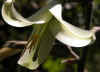
Spikes of large, beautiful, three-petaled lime green flowers to 2 - 6 feet
tall. Forms a nice rosette of narrow 2 foot leaves. Argentina. Quite striking
and beautiful. Aged seed germinates in 2 - 10 weeks and up, fresh seed needs
GA-3 and gives high germination in 2 weeks.
—Puya Raimondii GP2609. (20) PUYA-72. Packet: $7.00
Nice Photos: http://www.sciencedump.com/content/puya-raimondii-plant-blooms-once-every-100-years
Conservation status: http://www.iucnredlist.org/details/full/168358/0
'QUEEN of the ANDES', 'CUNCUSH'. Giant endangered bromeliad forming yucca-like
balls of narrow leaves, to 10 feet across. Sends up a huge flower spike to 30 -
40 feet tall, with thousands of 2" white flowers, then dies. Peru and
Bolivia. Zone 9, perhaps colder. Collected at 12,000 feet, Peru. Germinates in 4
- 8 weeks warm. For more seeds and plants grown by plant-explorer Ben Kamm,
including many Andean rarities, see his website at www.sacredsucculents.com
[ Home ] [ Up ] [ Seedlist A-AK ] [ Seedlist AL-AN ] [ Seedlist AP-AZ ] [ Seedlist B ] [ Seedlist CA ] [ Seedlist CE-CL ] [ Seedlist CN-CZ ] [ Seedlist DA-DE ] [ Seedlist DI-DZ ] [ Seedlist EA - ER ] [ Seedlist ES - EZ ] [ Seedlist F-G ] [ Seedlist H ] [ Seedlist I-K ] [ Seedlist LA-LE ] [ Seedlist LI ] [ Seedlist LO-LZ ] [ Seedlist M ] [ Seedlist N ] [ Seedlist O-PA ] [ Seedlist PE-PH ] [ Seedlist PI-PZ ] [ Seedlist Q-R ] [ Seedlist SA-SH ] [ Seedlist SI-SZ ] [ Seedlist TA-TO ] [ Seedlist TR-TZ ] [ Seedlist U-V ] [ Seedlist W-Z ] [ Vegetable Seed A - D ] [ Vegetable Seed E - R ] [ Vegetable Seed S - Z ] [ Organic Seeds ] [ Books ] [ Bulk Seed List ] [ Reserved Access ]