LEGUMINOSAE. Spectacular hardy small trees and shrubs valued for their pendulous yellow racemes and graceful habit. Hardy to at least Massachusetts (Zone 4) and standing poor rock soil. Pest free. Nick and soak seed to germinate in about 3 weeks.
—Laburnum alpinum. (100) LABN-2. Packet: $2.50
Ounce: $7.50, 1/4 Pound: $20.00
'SCOTCH LABURNUM'. Bright yellow 1/2" flowers in long slender pendulous 15" racemes in summer. Hardy tree to 30 feet, with shiny deep green foliage. Mts. of S. Europe. Zone 3. Nick seed to germinate in 1 - 3 weeks.
—Laburnum anagyroides. (100) LABN-4. Packet: $2.50
Ounce: $7.50, 1/4 Pound: $17.00
'GOLDENCHAIN TREE'. Yellow, pea-like 3/4" flowers in pendulous 4 - 12" racemes resembling a yellow Wisteria, in May and June, followed by 2" pods. Graceful small tree to 20 feet or more, with trifoliate 3" leaves. Central and South Europe. Zone 3. Long-lived; one planted in 1601 was 56 feet tall in 1937. Very hard durable wood used as an ebony substitute. Leaves used as a no doubt dangerous tobacco substitute, and the seeds are rich in the poisonous insecticidal alkaloid cytisine. Nick seed to germinate in 1 - 3 weeks.
LACTUCA (lak-TOO-ka)
COMPOSITAE. Tall annuals, biennials and perennials grown for ornament, food, seed oil, and medicine.
—Lactuca virosa. (100) LACT-24. Packet: $2.50
INQUIRE FOR BULK
Click for photo »
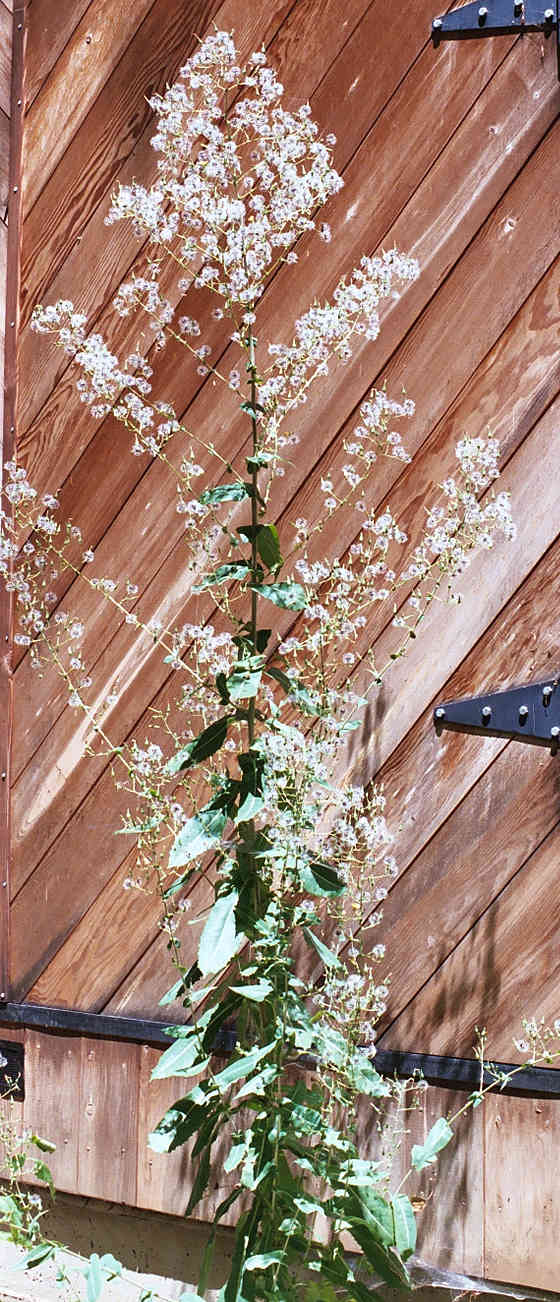
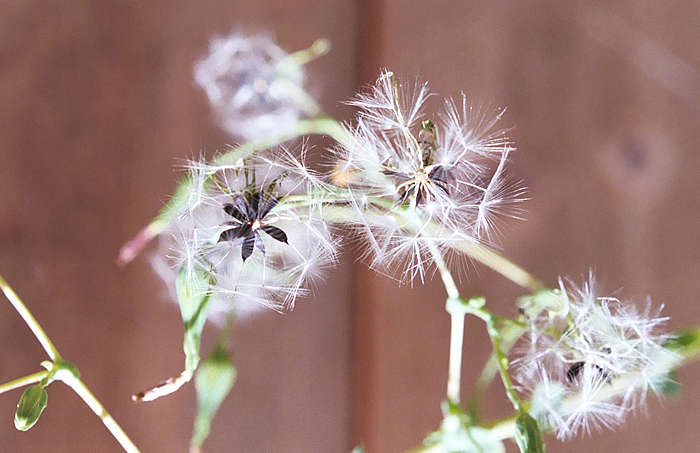
'WILD LETTUCE'. Light yellow 1/2" flowers in large airy clusters. Hardy biennial to 3 - 6 feet. Europe. Sow any time, spring to late summer. Crosses of this with L. scariola sometimes show enlarged leaves more like garden lettuce than either of the parents. A re-domestication of lettuce might be an interesting project. The bitter milky juice was formerly used in medicine. Germinates best in part shade, in about 1 - 6 weeks.
LAGENARIA (la-je-NAR-ee-a)
CUCURBITACEAE. 'GOURD'. Tender long-running tropical vines. Easily grown musky-scented plants. Give warm rich soil and full sun. Start indoors early in the North, and grow like squash. Pantropical and independently domesticated in both hemispheres. Includes the hard-shelled, white flowered Calabash Gourds, Cucuzzi Squash, Snake Gourd, and New Guinea Bean. Some lots more or less dormant. Clip pointed end of seed and use GA-3 for best germination in 2 - 3 weeks.
—Lagenaria siceraria 'Bushel Gourd'. (10) LAGS-6B. Packet: $3.00
Very large round gourds, sometimes up to 4 - 5 gallon capacity. Used for containers, drums, etc.
LATHYRUS (LATH-ee-rus or la-THY-rus)
LEGUMINOSAE. Showy climbing and upright annuals and perennials, including the familiar 'Sweet Pea'. Grown for their lovely, often fragrant flowers of many shades of blue, violet, red, white or yellow. Excellent, quick-growing plants, perfectly adapted to trellises, fences, or allowed to sprawl as a colorful groundcover on sunny slopes. The perennials are easily grown in any garden soil, giving a good display year after year without attention. The annuals need a deep, rich moist soil and full sun. Pick pods to prolong bloom. Germinates in 1 - 3 weeks.
—Lathyrus odoratus 'Heirloom Mix'. (50) LATH-36HX. Packet: $2.00
Ounce: $6.00, 1/4 pound: $15.00
'HEIRLOOM SWEET PEAS.' Blend of highly fragrant heirloom varieties in shades of rose, lavender, purple, salmon, and white. Excellent cut flowers. Best in full sun.
—Lathyrus odoratus 'High Scent'. (50) LATH-36HS. Packet: $2.00
Ounce: $7.50, 1/4 pound: $18.00
Bred for fragrance, the large white flowers have purple-tinged edges, and are the mo
—Lathyrus odoratus 'Royal Family'. (50) LATH-36RF. Packet: $2.00
Ounce: $6.00, 1/4 Pound: $15.00
'SWEET PEAS'. Lovely mix of fragrant large flowers in bright colors- reds, pinks, oranges, whites and purples. Withstands heat. Long-lasting cut flowers. This mixture is now difficult to find.
LATUA (la-TOO-a)
SOLANACEAE. A single species.
—Latua pubiflora. (20) LATU-4. Packet: $7.00
Gram: $30.00
'LATUE', 'PALO de BRUJA'. Beautiful violet 1 1/2" pendulous flowers followed by small yellowish berries. Shrub to 6 - 20 feet, with grey-green 1 - 3" leaves and variable thorns, sometimes almost thornless. Endemic to central Chile. Zone 8. Used by the Mapuche medicinally and as a Datura-like deliriant. Germinates in 1 - 8 weeks, GA-3 or cold helps. For more seeds and plants grown by plant-explorer Ben Kamm, including many Andean rarities, see his website at www.sacredsucculents.com
"Live as if you are going to die tomorrow, garden as if you are going to live forever."—Joan Kipling
LAVANDULA (la-VAN-du-la)
LABIATAE. 'LAVENDER'. Aromatic perennials and shrubs grown for their attractive bloom, handsome foliage and delightful fragrance. They prefer full sun, and light, dry, limey soil, rich soil reducing yield. South facing slopes are best. Clip frequently to induce bushiness. Hardy to about zone 5. Sow in fall or spring, as they germinate best at cool temperatures. Or prechill 6 - 12 weeks to germinate in 1 - 12 weeks. Seed viable 5 years. Cut flowers in morning or evening, and dry in a cool, shaded place.
—Lavandula officinalis. (=vera) (100) LAVA-7. Packet: $2.50
1/4 Ounce: $7.50
'TRUE or ENGLISH LAVENDER'. Lavender 1/2" flowers with purplish calyces, in long-stemmed spikes. Narrow grey green 2" leaves. Rounded shrub to 1 - 3 feet. Mediterranean region. Zone 5. An ancient herb, used by the Romans in their baths, and in their salads. It is mentioned by Shakespeare, and is much used to this day for strewing, perfume, scenting clothes, medicine, etc. A good honey source. Good cut flowers. The flowers were candied in former times, and they are good in salads, wine, and vinegar. Give seed 6 weeks prechill, or GA-3 and light, to germinate in 1 - 2 weeks.
LAVATERA (la-va-TER-a)
MALVACEAE. Easily grown herbs and shrubs with showy Hibiscus-like flowers, and often maple-like leaves. Best in full sun and average soil, giving profuse bloom all summer. Curious disjunct range.
—Lavatera arborea. (50) LAVT-3. Packet: $2.50
10 grams: $7.50, 50 grams: $28.00
'TREE MALLOW', 'TREE GERANIUM'. Clustered purple-red 1 1/2" flowers with darker veins in the center, resembling the zebra mallow. Blooms June to September. Shrub to 10 feet, with downy 3 - 9" lobed leaves. South Europe. Zone 7. Very attractive in both foliage and flower, good in the greenhouse or on the coast. Nick seed to germinate in 1 - 2 weeks. "This was handed to me 'over the fence' by a neighbor in 1979. From that single plant I have had at least one on the property for almost 40 years."—L. Martinez, California.
LAWSONIA (law-SOW-nee-a)
LYTHRACEAE. A single species.
—Lawsonia inermis var. alba. (500) LAWS-4A. Packet: $2.50
10 grams: $7.50
'HENNA', 'MIGNONETTE TREE'. Very fragrant small white flowers with crisped petals on a small tree to 20 feet. Africa and Asia. Zone 9. Grown since ancient times for the leaves which are used to dye the hair a coppery reddish color. Bees are attracted to the sweetly-scented flowers, which are used by the Swahili for perfume. Medicinal. GA-3 helps germination, which takes 4 - 8 weeks or so. Germination rate is generally low.
"All civilization does is hide the blood and cover up the hate with pretty words!"—U. K. LeGuin.
LEONTOPODIUM (le-on-to-PO-de-um)
COMPOSITAE. Low woolly hardy alpine perennials of Eurasia and the Andes, with star-like floral bracts. Best in light, well-drained soil and full sun.
—Leonotpodium alpinum. (250) LEOT-1. Packet: $2.50
'EDELWEISS'. White woolly flowers on a creeping hardy perennial to 12". High Alps. Zone 4. Germinates in 2 - 8 weeks.
LEPIDIUM (le-PI-dee-um)
CRUCIFERAE. Herbaceous plants, many eaten.
—Lepidium peruvianum 'Black Root'. (40) LEPI-64B. Packet: $5.00
'MACA'. A black-rooted variety. Germinates in 2 - 3 weeks.
"Busy, curious, thirsty fly, Drink with me, and drink as I."—William Oldys, On a Fly Drinking out of a Cup of Ale, (1696 - 1761).
LESSINGIANTHUS (le-sin-jee-AN-thus)
COMPOSITAE. Tropical American plants.
—Lessingianthus asteriflorus BK10509.12. (20) LESS-4. Packet: $4.00 OUT OF STOCK
'ORQU YURAK URAK'. Bright purple thistle-like flowers on a perennial to 4 feet, with blue-green leaves. From 10,000 feet near Inkallajta, Cochabamba Bolivia. Zone 8. Resprouts from the roots after frost. Used for respiratory infections. Germinates in 2 weeks warm. For more seeds and plants grown by plant-explorer Ben Kamm, including many Andean rarities, see his website at www.sacredsucculents.com
LEVISTICUM (le-VIS-ti-kum)
UMBELLIFERAE. 'LOVAGE'. A single species of hardy perennial herb grown for the seeds used as flavoring. Best in rich moist soil and full sun. Sow in fall or early spring to germinate in 2 - 3 weeks. Space 1 - 3 feet apart. Seed viable 3 years.
—Levisticum officinale. (100) LEVI-1. Packet: $2.50
10 grams: $7.50
'LOVAGE'. Tall perennial with shining dark green leaves in mounds to 2 - 3 feet. Tall 6 foot flower stalks topped with umbels of small yellow flowers in June and July, followed by strongly aromatic seeds. Alpine Europe. Zone 3. The fresh chopped leaves are an excellent addition to salads, stews and soups. The thick leafstalks can be eaten fresh like celery or candied like Angelica. Dried leaves make a nice tea. Seeds and root used for flavoring cordials and in perfumery. Germinates in 2 - 3 weeks warm.
LEWISIA (lew-ISS-ee-a or lew-iss-EE-a)
PORTULACACEAE. About 20 species of attractive hardy perennials named for Capt. Meriwether Lewis of the Lewis and Clark expedition. Good in the rock garden or among alpines, best in very well-drained gravelly, sandy soil, kept moist in spring and dry in summer. Germinates irregularly, best after 4 - 10 weeks cold treatment, may take 13 days and up to a year; usually 1 - 2 months. Best at cool temperatures and light may help, try surface sowing.
—Lewisia Cotyledon. (100) LEWI-6. Packet: $2.50
Inch wide white to pink flowers, each petal with a dark stripe, in panicles to 4 - 12" tall, above a star-like rosette of leaves. N. California, Oregon. Produces offsets. Germinates in 8 - 12 weeks at 40°. Also gives fair germination in 2 weeks warm temperatures.
—Lewisia Cotyledon 'Sunset Strain'. (75) LEWI-6S. Packet: $2.50
Abundant inch-wide flowers in shades of red, pink, orange, and yellow, often with striped petals. Hardy perennial to 6", with a rosette of succulent leaves. Zone 3. Prechill seed 6 - 8 weeks to germinate in 1 - 2 weeks.
—Lewisia Tweedyi. (25) LEWI-28. Packet: $4.00
Large cream 2" wide flowers with pink-tipped petals, in May and June. Hardy perennial to 4 - 8". Mountains of Washington and B.C. Zone 4. "The large flowers make it the most attractive of all Lewisias for the garden."—Hortus Third. Prechill.
LEYCESTERIA (lay-ses-ter-EE-a)
CAPRIFOLIACEAE. 'HIMALAYAN HONEYSUCKLE.' Himalayan shrubs with funnel-shaped flowers in nodding spikes. Easily grown outdoors in the South and in sheltered places in the North. Easy from seed, flowers in 3 - 4 years. Interesting plants.
—Leycesteria formosa. (250) LEYC-9. Packet: $2.50
'FLOWERING NUTMEG', 'HIMALAYAN HONEYSUCKLE', 'PHEASANT BERRY'. White 3/4" flowers in pendant 4" spikes, with claret-red bracts, in August - September. Shiny purple-black berries, Strong growing deciduous shrub to 6 feet, with 7" leaves. Himalayas. Zone 6. "Berries bitter but delicious with sugar and milk. Diluted with water, they make a refreshing drink, sweetened to taste. Unique flavor. My favorite soft fruit."—J.L. Germinates in 1 - 3 weeks.