J. L. HUDSON, SEEDSMAN, BOX 337, LA HONDA, CALIFORNIA 94020-0337 USA
2008 SEEDLIST - Reserved Access ListReserved Access
Only the seeds on this page are limited-access—not to restrict availability, but to encourage successful propagation.
(About Reserved Access) All other seeds are unrestricted access.
To receive these seeds, simply write on your request "I agree to the reserved-access terms."
NOTE: We do not supply these seeds unless you include the sentence: "I agree to the reserved-access terms."
on your request!
Two types are reserved-access: rare, threatened, or endangered species, and seeds with prolonged, irregular, uncertain, or exacting germination requirements. To insure they reach experienced, qualified propagators, and to weed out "consumer-types", we reserve access to these seeds to those who:
1. Agree to propagate and distribute the plants, and to share their germination results.
2. Agree to distribute solely in the public domain—no patents, trademarks, or other intellectual property.
3. Commercial propagation is encouraged, but in the unlikely event that large-scale commercial distribution is achieved, benefit-sharing
along the path towards the source, in accordance with the spirit of the International Convention on Biological Diversity, will be undertaken.
4. Absolutely, positively, NO refunds or replacements for any reason other than out-of-stock!
Thanks for helping insure that we can continue to distribute these special seeds!
ACACIA
NEW—Acacia simplicifolia (=simplex) (5,h) R-ACAC-117. Packet: $6.00
10 seed: $10.00, 50 seed: $35.00, 100 seed: $50.00
Extremely rare tree or shrub to 40 feet, with broad, oval, pointed 2 - 4" leaves, and small flower-balls followed by 6" pods. Endemic to New Caledonia and Vanuatu, often growing in seashore dunes. Does well in
Florida — try it in S. California and Texas. Nick seed to germinate in 2 - 4 weeks. Alkaloid-rich, and scarce as hen's teeth!
A way to maximize germination of these expensive seed: Nick seed with a file then soak for 15
minutes in a solution made of 1 part household bleach and 8 parts water. Rinse them well. Fold a
paper towel into quarters and put on a plate that has been sterilized with bleach. Moisten the towel
with distilled water and put the seeds (nicked side down) on the towel and cover with plastic wrap,
leaving an air space above the seeds. Keep in a warm place (70-80°F) and inspect every day. Any
seeds that don't swell in a day or two should be re-nicked and sterilized. Any seeds that develop
mold should be removed and re-sterilized and put on a separate plate - most of these will sprout,
too, but this keeps the others clean. When the roots are a half-inch long, plant the seed in a
light, well-drained seed-starting mix, and keep warm. If you have had trouble with these in the
past, try this method and you are sure to be successful! Gives high germination with this method.
ACRONYCHIA (ak-ro-NI-kee-a)
RUTACEAE. Small trees of SE Asia, Australia, & the Pacific, some with edible fruits.
NEW—Acronychia imperforata. (5,v) R-ACRO-20. Packet: $2.00
'LOGAN APPLE'. Creamy, four-petaled flowers, summer to fall. Shrub or small tree to 50 feet, with 3/4" leaves. Yellow fruits said to be edible. Salt tolerant, from coastal Australian
rainforests. Each nut contains several seed, and germination is prolonged.
ANIGOZANTHOS (a-nig-o-ZAN-thos)
HAEMODORACEAE. Odd, half-hardy or tender perennials with peculiar woolly flowers and sword-like
leaves rising from a thick rootstock. Grow outdoors in California and the South. The cut flowers are
excellent fresh or dried. Nectar-seeking birds are attracted to them. Best in well-drained soil, and
keep dry during the winter rest. Sow on soil surface, keep moist. May take up to 1 - 3 months to
germinate at 60 - 70°F. Hot water soak may help. After 1st spring, leave pots to bake dry in the
sun all summer, and more seed will germinate the 2nd spring. Most are easy from seed, and seed is
viable for at least ten years. Smoke treatment may help germination.
—Anigozanthos flavidus Yellow Green. (b,h) R-ANIG-9Y. Packet: $2.00
'ALBANY' or 'TALL KANGAROO PAW'. Odd curved yellow green 1 1/4" flowers on branching spikes
to 4 - 6 feet, summer to fall. West Australia. The hardiest species. Roots said to be eaten roasted.
Germinates in 4 weeks; improved by GA-3.
—Anigozanthos humilis. (b,v) R-ANIG-11. Packet: $2.00
'CAT'S PAW', 'QUOLL'S PAW'. Large clusters of 2" paw-like flowers in shades of yellow, orange,
and red. The smallest species, with narrow 6 - 8" leaves. Western Australia. GA-3 or smoke may
help germination.
NEW—Anigozanthos Manglesii. (b,g) R-ANIG-16. Packet: $2.00
'KANGAROO PAWS'. Stunning, vivid red and green woolly 3" flowers really do resemble
kangaroo paws. To 3 - 6 feet, excellent for cut-flowers. Prefers light soil and will not tolerate
cold wet areas. The floral emblem of Western Australia. An excellent species, will survive to Zone
8.
ARGEMONE (ar-je-MOE-nee)
PAPAVERACEAE. 'PRICKLY POPPY', 'ARGEMONY'. Showy annuals grown for their magnificent,
poppy-like, yellow, white or purple flowers and for the striking foliage. Easily grown, standing
hot, dry, barren soils and drought. Sow where they are to stand, or transplant from pots. Seed
germinates readily in some species, others need to be fall sown, and some need GA-3. Seed half-life
4 - 5 years. "Handsome and unusual." —Booth.
—Argemone mexicana. (b,v) R-ARGE-16. Packet: $2.00
'PRICKLY POPPY', 'CHICALOTE', 'DEVIL'S FIG'. Large bright lemon yellow to orange 2 - 3" wide
satiny, poppy-like flowers borne profusely on a thistle-like hardy annual to 1 - 3 feet. Attractive
blue-green leaves variegated silvery. Tropical America. Good in hot, dry stony places, but thrives
in the garden. Sometimes flowers all year here in California, and is sometimes a short-lived
perennial. Sow in fall or give GA-3 and 4 months cold to germinate in 4 - 7 months at cold
temperatures.
ARUM (AR-um)
ARACEAE. Jack-in-the-pulpit-like tuberous perennials with arrowhead-shaped leaves and
interesting spathes. Good pot plants or outdoors in mild climates. Best in part shade and rich soil,
with plenty of water while growing. germination prolonged and irregular, hold pots outdoors several
years.
NEW—Arum concinnatum tubers see Perishable
Items page.
NEW—Arum creticum tubers see Perishable Items
page.
NEW—Arum cyrenaicum tubers see Perishable
Items page.
NEW—Arum dioscoridis var. syriacum tubers see Perishable
Items page.
NEW—Arum italicum Marmoratum tubers see Perishable
Items page.
—Arum italicum. (e,g) R-ARUM-12. Packet: $2.00
Foot-long arrowhead-shaped leaves with conspicuous silvery white veins. Large 6 - 12"
spathe with lighter veins, followed by attractive clustered bright red berries in fall. England to
North Africa. Fairly hardy (Zone 4) perennial to 2 feet. Easy in sun or shade, and good in pots.
When blooming it gives off heat and is warm to the touch. Germination prolonged.
—Arum maculatum. (e,g) R-ARUM-16. Packet: $3.00
'CUCKOO-PINT', 'ADAM & EVE'. Green spathes to 10" long, often spotted with purple, in
early spring, followed by clustered bright red berries in August and September. Hardy perennial to 1
foot, with 10" arrowhead-shaped leaves, often mottled with purple. Europe. Formerly used as an
acrid medicine. The spathe generates heat when blooming. Easy and nice in pots. Germination
prolonged.
BOMAREA (bo-MAR-ee-a)
LILIACEAE. Tropical American twiners related to Alstroemeria, grown for their clusters of beautiful flowers. Good in the cool greenhouse, or outdoors in part shade in California and the South. Dies back in winter. Germination may be
prolonged—try GA-3.
NEW—Bomarea Caldasii. (e,v) R-BOMA-12. Packet: $3.00
Large showy clusters of 2" bell-shaped yellow-orange flowers with dark spots and reddish tepals.
Twining vine to 10 - 17 feet, with 6" leaves. Northern S. America. Germination prolonged-try GA-3.
CARDIOCRINUM (kar-dee-o-KRI-hum)
LILIACEAE. Giant Himalayan lilies, grown for their striking display.
—Cardiocrinum giganteum. (d,v) R-CARDI-12. Packet: $3.00
'G1ANT HIMALAYAN LILY'. The most magnificent of all lilies, reaching 9 - 12 feet tall, with
racemes of 6 - 20 deliciously scented white flowers, each 6" long and nearly as wide. May &
June. Large heart-shaped leaves. Himalayas, in damp, shady forest, 7500 to 10,600 feet. Easily grown
in light sandy soil. Hardy to Boston. Sow in fall outdoors to germinate and give top growth the next
spring. Flowers in 5 - 6 years.
CAREX (KAR-ex)
CYPERACEAE. 'SEDGE'. A large genus of about 900 species of grass-like plants. Many are nice
bog-plants. Many make attractive tufted clumps, good at pond's edge. Most species need light to germinate.
NEW—Carex obnupta. (b,v) R-CARE-107. Packet: $2.00
'SLOUGH SEDGE'. Attractive graceful 2 - 4" blackish-brown spikes on 2 foot stems. Narrow, grass-like 1 - 3 foot leaves. West coast N. America.
Forms nice colonies in sun or part shade, moist soil. Drought-resistant once established. May need prechill and light-surface sow.
CIMICIFUGA (si-mi-SI-fu-ga)
RANUNCULACEAE. Tall, stately, North Hemisphere woodland perennials grown for their slender spikes of
flowers and handsome foliage, and also for their valuable medicinal roots. Good in part shade.
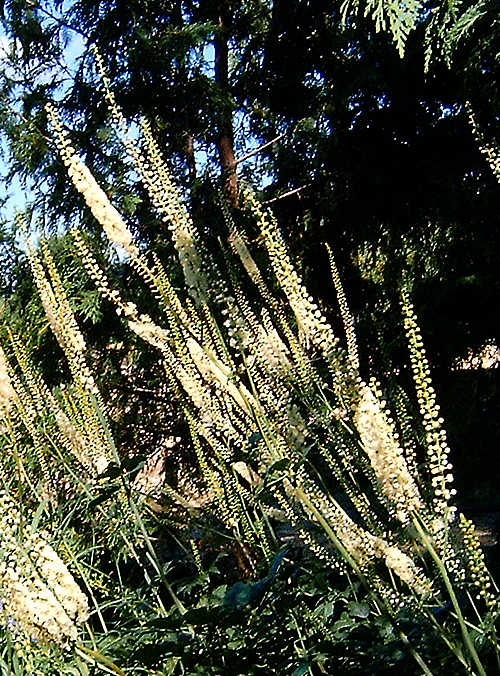
—Cimicifuga racemosa. (c,h) R-CIMI-21. Packet: $2.50 Click for photo »

'BLACK COHOSH', 'BLACK SNAKEROOT'. Narrow spikes of small white flowers, up to 2 feet long, in July
and August. Bold perennial to 8 feet, with shiny, dark green compound leaves. E. N. America. Very
showy and good in rich moist soil and part shade. The valuable medicinal roots are one of the best
remedies for problems associated with menopause, PMS, ringing in the ears, and depression. Seed
needs 2 - 10 weeks warm, then 12 weeks cold to germinate. Hold pots 3 years.
—Cimicifuga ramosa atropurpurea. (c,v) R-CIMI-23A. Packet: $3.00
Attractive purple-red palmately-lobed foliage, on a tall hardy perennial to 6 feet, with nodding
16" racemes of small creamy flowers in fall. Kamchatka. Zone 4. Give 6 weeks warm, then 6 - 8
weeks cold, and hold pots over two years.
COMMELINA
NEW—Commelina communis. (e,v) R-COMM-16. Packet: $2.00
'DAYFLOWER'. Dark blue flowers with a small white petal. Sprawling annual to 1 - 3 feet. with 3 - 5" pointed leaves. E. Asia. The flowers,
young leaves, and shoots are cooked as a potherb. Dormant seed.
EMINIUM (e-MIN-ee-um)
ARACEAE. Odd Eurasian aroids with large spathes. Dry regions. May have multi-cycle germination.
NEW—Eminium spiculatum. (5,v) R-EMIN-17. Packet: $6.00
Rare aroid to 10", with a chocolate-purple spadix in May or June, and arrowhead-shaped leaves.
Turkey to Iraq and the Sinai. Zone 7. This
is fresh crop for 2008. In
the print edition of the 2007 supplement, I accidentally inserted the wrong species name from my files,
so it read Eminium nigrum. I goofed! The description is correct, but the species is spiculatum.
Sorry for any inconvenience this causes!
EUPHORBIA
Dormant species may need cold, nicking, or GA-3.
NEW—Euphorbia enopla. (e,g) R-EUPH-40. Packet: $2.00
'BOKNOORS'. Cactus-like succulent shrub to 1 - 3 feet, with many 2" thick, 6 - 7 -angled branches with red to purple 1 - 2" spines. Flowers have striking dark red bracts. S. Africa. Zone 7. CITES Appendix II endangered species.
Germinates in 1 - 3 weeks.
NEW—Euphorbia inermis. (e,f) R-EUPH-70. Packet: $2.00
Clumps of foot-long, finger-like, succulent, knobby stems rise from a thick candex to 6" across. Small woolly-white flowers in spring and summer. S.
Africa. Zone 9. CITES App. II endangered species. Germinates in 1 - 3 weeks, and GA-3 may help.
NEW—Euphorbia pentagona. (d,v) R-EUPH-109. Packet: $3.00
Cactus-like shrub to 10 feet, with many 1 1/2" thick, 5 - 8-angled branches, bright glossy green turning grey with age. Small buff-lavender flowers.
S. Africa. Zone 7. CITES App. II endangered species. Seed dormant, try GA-3.
NEW—Euphorbia polygona. (e,f) R-EUPH-124. Packet: $2.00
Branching cactus-like shrub to 5 feet, with 4" thick, 7 - 20-angled stems, with 3/8" spines. Dark purple flowers. S. Africa. CITES App. II endangered species.
Germinates in 1 - 3 weeks, GA-3 may help.
NEW—Euphorbia schoenlandii. (d,g) R-EUPH-136. Packet: $2.00
Weird 8" thick stems with spiny tubercles, sometimes resembling a green pineapple. May reach 4 feet tall, rarely branched. S. Africa. CITES Appendix II endangered species. Germinates in 1 - 3 weeks.
HEPATICA (he-PA-ti-ka)
RANUNCULACEAE. Small hardy perennials of northern regions, related to Anemone. Does well in cool, shady woodlands in humusy soil.
NEW—Hepatica nobilis. (e,v) R-HEPA-17. Packet: $3.00 OUT OF STOCK
Abundant inch-wide anemone-like flowers in blue shades, on 4 - 6" stems. Hardy perennial with heart-shaped, three-lobed, often purplish leaves.
Eurasia. Zone 5. Give seed warm, then cold, to germinate at cold temperatures.
LEUCHTENBERGIA (look-ten-berg-EE-a)
CACTACEAE. A single endangered species.
—Leuchtenbergia principis. (e,g) R-LEUCH-4. Packet: $2.00
Peculiar cactus with elongated grey-green tubercles tipped with papery 4" spines. Somewhat
resembles an Agave. Reaches 2 feet tall, with golden-yellow 3" flowers. México,
where is is used medicinally. A
CITES Appendix I endangered species, cannot be sent out of the U.S. Well-drained soil. Can bloom in 4 - 5 years.
Use GA-3 to germinate in 3 - 4 weeks.
LUNARIA (loo-NAR-ee-a)
CRUCIFERAE. Old fashioned annuals and perennials grown for their attractive, sweet-scented
flowers and the large, flat, silvery pods used in dried arrangements. Easily grown, standing poor
soil, part shade, and drought. Reseeds well. Sow early in spring or fall in mild climates.
—Lunaria rediviva. (10,h) R-LUNA-4. Packet: $2.00
5 grams: $10.00, 10 grams: $16.00
'PERENNIAL HONESTY'. Handsome hardy perennial to 4 - 7 feet, with larger and lighter-colored
flowers than L. annua, and with pods much longer than wide. Blooms in May & June. Europe. An odd
and interesting counterpart to the common species. "A stately plant." —I. Grabo.
Seed highly dormant.
MANDRAGORA (MAN-dra-GOR-a)
SOLANACEAE. Famous hardy stemless perennials of myth, magic and medicine. Good in the border or wild garden in well-drained soil and part shade.
NEW—Mandragora turcomanica. (5,g) R-MANDR-23. Packet: $7.00 Click for photo »

10 seed: $12.00, 25 seed: $25.00, 50 seed: $40.00
An extremely rare species, said to be possibly extinct in the wild, and fewer than 300 plants in cultivation. Large purple and cream bell-shaped flowers in the center of a rosette of large 1 - 2 foot crinkled leaves with white mid-ribs. Fruits like a yellow-orange tomato. Makes big rosettes a yard or more across, from a thick, branching, alkaloid-rich root. Originally native to only a small area of NE Iran and adjacent Turkmenistan, where local villagers would harvest them for medicine, or transplant them to gardens for the highly aromatic leaves and fruits. Some have proposed this as a source of 'soma', and it has been used as an aphrodisiac.
Seed has been primed with GA-3, and will give good germination in 1 - 3 months or so.
PHYTOLACCA
—Phytolacca insularis. (d,v) R-PHYO-12. Packet: $3.00
Rare Korean endemic, a large plant to over 10 feet tall, with reddish stems. The leaves contain
an anti-viral protein. Listed as endangered by the Korean government.
ROMNEYA (ROM-nee-a)
PAPAVERACEAE. Two species.
NEW—Romneya Coulteri. (d,v) R-ROMN-1. Packet: $3.00
'MATILIJA POPPY' (pronounced ma-TEE-leeya). A magnificent shrub to 3 - 8 feet, with huge crinkled papery white fragrant flowers to 6" across, with bright yellow stamens, staying open for several days. Divided leathery grey-green foliage. Canyons of south coastal California, but surprisingly
hardy and successful in the North if planted by a south-facing wall. Germinates best with gibberellic acid or try burning leaves over the flat and cold, may
take 2 years to sprout. Difficult but worth it.
TRICHOSANTHES (tri-ko-SAN-theez)
CUCURBITACEAE. Tendril -climbing annual or perennial vines grown for food and medicine. Easy in
a warm sunny spot and rich soil.
NEW—Trichosanthes cucumerina (=anguina) (5,v) R-TRCS-8. Packet: $2.00
'SNAKE GOURD'. Large white flowers with fringed petals, followed by slender, often coiled 1 - 6
foot long fruits. Large annual vine with 9" leaves. S. Asia to N. Australia. The young gourds
are eaten like green beans. This lot from wild plants in Australia, and is dormant. Try GA-3.
TROPAEOLUM
NEW—Tropaeolum speciosum. (5,v) R-TROP-40. Packet: $4.00
'FLAME FLOWER'. Vermillion-red 1 1/2" flowers followed by bright blue berries. High-climbing vine to 10 feet or more, with 5 -
7-lobed leaves. Chile. Zone 8. Give seed 4 weeks warm, then shift to cold, and leave at cold till stem shows, up to 3 months.